Secure 100% Exam Results with Juniper JN0-481 Practice Questions [2026]
Wiki Article
DOWNLOAD the newest TestPassed JN0-481 PDF dumps from Cloud Storage for free: https://drive.google.com/open?id=17PEJMBByPrK4AtEh8pwADbEcCvX8bMwi
Your eligibility of getting a high standard of career situation will be improved if you can pass the exam, and our JN0-481 practice materials are your most reliable ways to get it. You can feel assertive about your exam with our 100 guaranteed professional JN0-481 practice materials, let along various opportunities like getting promotion, being respected by surrounding people on your profession’s perspective. All those beneficial outcomes come from your decision of our JN0-481 practice materials. We are willing to be your side offering whatever you need compared to other exam materials that malfunctioning in the market.
Juniper JN0-481 Exam Syllabus Topics:
| Topic | Details |
|---|---|
| Topic 1 |
|
| Topic 2 |
|
| Topic 3 |
|
| Topic 4 |
|
| Topic 5 |
|
| Topic 6 |
|
>> Valid JN0-481 Exam Syllabus <<
Advantages Of Juniper JN0-481 PDF Dumps Format
According to different kinds of questionnaires based on study condition among different age groups, our JN0-481 test prep is totally designed for these study groups to improve their capability and efficiency when preparing for Data Center, Specialist (JNCIS-DC) JN0-481 Exams, thus inspiring them obtain the targeted Juniper JN0-481 certificate successfully.
Juniper Data Center, Specialist (JNCIS-DC) Sample Questions (Q14-Q19):
NEW QUESTION # 14
You staged several changes to your Juniper Apstra blueprint but have not committed them. In this scenario, what is the effect of selecting Revert?
- A. All the staged changes are cleared.
- B. Only the last staged change will be cleared.
- C. A commit is required to complete the revert operation.
- D. The current active configuration will be replaced by the previous active configuration.
Answer: A
Explanation:
In Apstra 5.1, blueprint changes follow an intent workflow: you edit intent in Staged, then review the delta in Uncommitted, and finally Commit to activate those changes and create a new revision. If you have staged changes that are visible under Uncommitted but decide not to proceed, the Revert action is used to discard them. Selecting Revert clears the blueprint's uncommitted intent delta and returns the blueprint to the last committed state (the currently active intended design baseline). In practical terms, it removes all pending edits that were made since the last commit-whether those edits were physical (links/topology), virtual (routing zones, virtual networks), policies (security policies), or catalog-driven operations-so that none of those changes will be deployed.
Revert is not a "single-step undo" limited to only the most recent change; it is a discard of the staged/uncommitted change set. It also does not roll back device configurations on its own (that is handled by revision operations such as Time Voyager rollbacks and subsequent deployment actions). Finally, Revert does not require a commit to take effect; it is used specifically to avoid committing changes. This behavior helps maintain clean operational control in EVPN-VXLAN fabrics by ensuring only validated and intentional intent updates are promoted to the deployed network state.
Verified Juniper sources (URLs):
https://www.juniper.net/documentation/us/en/software/apstra4.2/apstra-user-guide/topics/task/blueprint-commit-revert.html
https://www.juniper.net/documentation/us/en/software/apstra6.1/apstra-user-guide/topics/task/time-voyager-rollback-blueprint-revision.html
NEW QUESTION # 15
You have created a blueprint and are in the process of assigning systems. You require the leaf3-sonic device in the blueprint but do not want it to actively participate in the routing of the IP fabric.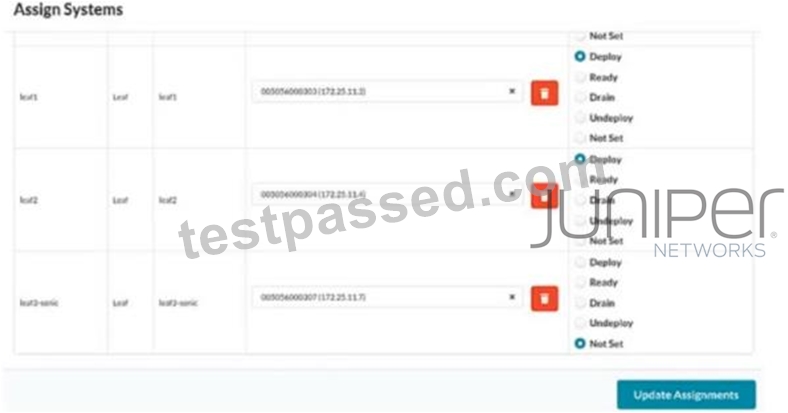
In the Juniper Apstra UI, which two modes satisfy this requirement? (Choose two.)
- A. Undeploy
- B. Drain
- C. Deploy
- D. Ready
Answer: A,D
Explanation:
Apstra deploy modes control how far a device progresses in the configuration lifecycle and whether it becomes active in the fabric. If you must keep leaf3-sonic present in the blueprint (modeled, cabled, and available for future use) but you do not want it to participate in IP-fabric routing, you use modes that keep the device not active.
Ready mode assigns the device to the blueprint and applies only "Ready (Discovery 2)" level configuration-hostnames, interface descriptions, and port speed/breakout settings-while explicitly keeping the device out of fabric routing. In this mode, Apstra does not configure routing/BGP or L3 interface addressing for the IP fabric, so the switch is staged and visible for validation (for example, LLDP wiring checks) but does not forward as part of the Clos underlay.
Undeploy mode removes the complete Apstra service configuration from the device. Operationally, this also ensures the device is not active in the fabric. It is commonly used when a device must be retained in the blueprint inventory/topology but should not be participating (for example, temporarily withdrawn, decommission preparation, or held as a spare).
By contrast, Deploy makes the device active (full rendered fabric configuration, including BGP), and Drain is a maintenance state used to gracefully remove traffic from an already-active device rather than a state for keeping it non-participatory from the outset.
Verified Juniper sources (URLs):
https://www.juniper.net/documentation/us/en/software/apstra6.0/apstra-user-guide/topics/topic-map/device-config-lifecycle.html
https://www.juniper.net/documentation/us/en/software/apstra4.2/apstra-user-guide/topics/topic-map/device-config-lifecycle.html
NEW QUESTION # 16
In the case of IP Clos data center five-stage fabric design, what are two rotes of the super spines? (Choose two.)
- A. Super spines connect to all spine devices within the five-stage architecture.
- B. Super spines are used to connect leaf nodes within a data center pod.
- C. Super spines are always connected to an external data center gateway.
- D. Super spines are used to interconnect two different data center pods.
Answer: A,D
Explanation:
In the case of IP Clos data center five-stage fabric design, the super spines are the devices that provide the highest level of aggregation in the network. They have two main roles:
Super spines are used to interconnect two different data center pods. A pod is a cluster of leaf and spine devices that form a 3-stage Clos topology. A 5-stage Clos topology consists of multiple pods that are connected by the super spines. This allows for scaling the network to support more devices and bandwidth.
Super spines connect to all spine devices within the five-stage architecture. The spine devices are the devices that provide the second level of aggregation in the network. They connect to the leaf devices, which are the devices that provide access to the end hosts. The super spines connect to all the spine devices in the network, regardless of which pod they belong to. This provides any-to-any connectivity between the pods and enables optimal routing and load balancing.
NEW QUESTION # 17
You are building an IP fabric and have decided to use Junos devices to create an EBGP underlay. You must ensure that traffic is load balanced throughout your fabric.
You must also ensure that regardless of the path used through the fabric that all traffic is handled consistently and load balanced predictably.
According to Juniper Networks, what are three best practices that you should employ to help you achieve the desired behavior? (Choose three.)
- A. Leaf devices should use a variety of link speeds for each uplink to the spine devices.
- B. All leaf devices should be the same model including linecards and port density.
- C. All spine devices should be the same model including linecards and port density.
- D. Each leaf device must use the same link speed for all uplinks to the spine devices.
- E. Each leaf device should be a different model including linecards and port density.
Answer: B,C,D
NEW QUESTION # 18
Off-box agents are consuming too much CPU and memory on your Juniper Apstra controller.
In this scenario, how would you solve this problem?
- A. Modify the agent profile to consume less resources.
- B. Use on-box agents instead of off-box agents.
- C. Add more CPU and memory to the Apstra controler VM.
- D. Create a worker VM to offload off-box agents from the Apstra controller VM.
Answer: D
Explanation:
When off-box agents consume too much CPU and memory on the Juniper Apstra controller, the best solution is to deploy a separate worker VM. The worker VM offloads off-box agent processing from the main Apstra controller VM, ensuring that the controller remains stable and responsive while still supporting large-scale or resource-intensive environments.
NEW QUESTION # 19
......
To keep pace with the times, we believe science and technology can enhance the way people study. Especially in such a fast-pace living tempo, we attach great importance to high-efficient learning. Therefore, our JN0-481 study materials base on the past exam papers and the current exam tendency, and design such an effective simulation function to place you in the real exam environment. We promise to provide a high-quality simulation system with advanced JN0-481 Study Materials. With the simulation function, our JN0-481 training guide is easier to understand and pass the JN0-481 exam.
JN0-481 Download Pdf: https://www.testpassed.com/JN0-481-still-valid-exam.html
- JN0-481 Quiz Torrent: Data Center, Specialist (JNCIS-DC) - JN0-481 Exam Guide - JN0-481 Test Bootcamp ???? ➡ www.testkingpass.com ️⬅️ is best website to obtain ⏩ JN0-481 ⏪ for free download ????JN0-481 Latest Exam Notes
- Valid JN0-481 Exam Sample ???? New JN0-481 Exam Duration ✴ New JN0-481 Test Tips ???? Open website { www.pdfvce.com } and search for 《 JN0-481 》 for free download ????Reliable JN0-481 Test Questions
- Exam-oriented JN0-481 Exam Questions Compose of the Most Accurate Practice Braindumps - www.easy4engine.com ???? The page for free download of ( JN0-481 ) on ➤ www.easy4engine.com ⮘ will open immediately ????New JN0-481 Exam Duration
- New JN0-481 Test Tips ???? Sample JN0-481 Questions ???? JN0-481 Latest Exam Materials ???? ➽ www.pdfvce.com ???? is best website to obtain [ JN0-481 ] for free download ????New JN0-481 Test Tips
- Reliable JN0-481 Test Questions ???? JN0-481 Valid Test Guide ???? JN0-481 Passguide ???? Search for ▷ JN0-481 ◁ and obtain a free download on ( www.examdiscuss.com ) ????Valid JN0-481 Exam Sample
- JN0-481 Dump Collection ???? JN0-481 Exam Bible ???? JN0-481 Practice Exam Online ???? Search for ▛ JN0-481 ▟ and obtain a free download on ➡ www.pdfvce.com ️⬅️ ????JN0-481 Dump Collection
- Exam-oriented JN0-481 Exam Questions Compose of the Most Accurate Practice Braindumps - www.exam4labs.com ???? ✔ www.exam4labs.com ️✔️ is best website to obtain { JN0-481 } for free download ????JN0-481 Latest Exam Materials
- New JN0-481 Test Tips ???? JN0-481 Valid Exam Registration ???? JN0-481 Practice Exam Online ???? ( www.pdfvce.com ) is best website to obtain ➠ JN0-481 ???? for free download ????New JN0-481 Exam Duration
- JN0-481 Latest Exam Materials ???? JN0-481 Reliable Exam Tips ⏲ JN0-481 Latest Exam Notes ???? The page for free download of ✔ JN0-481 ️✔️ on ➥ www.testkingpass.com ???? will open immediately ????JN0-481 Passguide
- Evaluate Yourself with Online Juniper JN0-481 Practice Test Engine ???? Search for 【 JN0-481 】 and download it for free immediately on ▷ www.pdfvce.com ◁ ????JN0-481 Passguide
- Exam JN0-481 Book ???? Latest JN0-481 Study Guide ???? JN0-481 Latest Exam Notes ???? Search for ✔ JN0-481 ️✔️ and download it for free on ⏩ www.pdfdumps.com ⏪ website ????Latest JN0-481 Version
- mnobookmarks.com, mediajx.com, keiranxxvn073715.blogdal.com, nicolasganq341367.azzablog.com, optimusbookmarks.com, secureedges.com, hannauanh856349.bloggazzo.com, tripsbookmarks.com, www.stes.tyc.edu.tw, hassanknlw221671.nizarblog.com, Disposable vapes
2026 Latest TestPassed JN0-481 PDF Dumps and JN0-481 Exam Engine Free Share: https://drive.google.com/open?id=17PEJMBByPrK4AtEh8pwADbEcCvX8bMwi
Report this wiki page